

Realism vs Formalism in cinema
In modern textbooks there are definitions of dozens, if not hundreds, of types, styles and directions in art. Cubism, impressionism, romanticism, classicism, futurism, modernism – the list is simply huge. But today we will focus on the trends that dominate the world of cinema, namely realism and formalism. What are these two directions and what should you know about them?


Let’s try to explain it in simple language, without using words that only an amazing film critic would understand. The essence of the direction of Realism is in the name.
Realism is an attempt to depict all the diversity of reality as naturally and adequately as possible (realistically).
If we talk about movies, it becomes even easier. Full realism is a documentary. It does not have actors, scenery, scripts or productions. Everything is shown naturally or, one might say, realistically. In fully realistic documentaries, we see the depiction of reality as it is, without artistic distortions or assumptions.
The most vivid examples of realism, surprisingly, are the first attempts at shooting movies. Such as, for example, the works of the Lumiere brothers – pioneers of world cinema. Films such as “The Arrival of the Train at the La Ciotat Station” or “The Exit of the Workers from the Lumiere Factory” are not only priceless cinema history, but also a perfect example of realism. No staging, script, editing or plot. Absolute reflection of reality.


Okay, we’re done with Realism. But how can we describe Formalism? Part of the definition of this direction also lies in the name. More precisely, the root word is “form”. “Form”, in this context, is nothing more than the visual part of the artwork: color, light, textures, compositions. Basically, “picture”.
Formalism is a direction in art in which only form (the visual part) is important and the absence of logic or meaning can be ignored.
To make things even simpler, the main aspect is that it should be beautiful, and it doesn’t matter why. From the cinema point of view, a completely formalistic film is one that has no plot, no logic, and no meaning. And there is only a set of beautiful, and often abstract, frames and compositions. In fact, a “beautiful” picture on its own is the meaning of formalism. As with realism, films made at the dawn of cinema can be cited as examples. “Andalusian Dog” by Luis Buñuel and Salvador Dali or “Metropolis” by Fritz Lang. And although there is a plot and logic in these films, they still lean towards formalism.


Now that we have figured out the definitions, it is important to understand the following: like in the real world, there is nothing absolute in cinema. After all, even the most “true” documentary has editing, sound design and other artistic elements that, in one way or another, distort reality. And even the most abstract and “art-house” film has at least some logic and action, otherwise the viewer will simply not understand or be interested. If you draw a scale between realism and formalism, then almost all of the films will be somewhere in the middle.
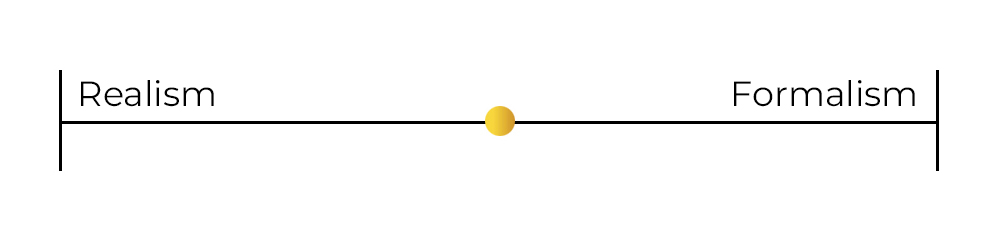
In fact, moviegoers have long understood that there is no point in obeying the laws of only one direction. After all, both realism and formalism have their strengths and weaknesses. We can take the modern blockbusters as an interesting example. “Star Wars” or “Avengers” are excellent representatives of mixing directions. They have formalistic elements: superheroes, space travel, magic, lightsabers, magic stones, etc. But at the same time, the actions of the characters are logical, their personalities are clear, and the plots are straightforward. Based on this, there is also realism there. Thus, the creators of these films balance between fiction and reality so that the viewer can “believe”.


A rather unusual example of a mixture of directions is advertising. Whether this art is real or not has been a subject of controversy for a hundred years. But, lets agree, it is not an easy task to quickly and effectively talk about the product while showing a good picture at the same time. Advertisers often use this method: the story is realistic, but the images are formalistic. Most likely, you have often seen this. Bright, saturated, perfectly composed shots that do not make any sense by themselves. But at the same time, the product is easy to understand and its advantages are extremely clear. This is a complete synthesis of two opposite directions. And believe me, it is very difficult.


In the end, I would like to say the following: in order to enjoy a film or TV series, it is not necessary to understand the art direction. If you like it, you like it. But in order to understand what you are shown on the screen and why, it is very important to have a set of basic knowledge on this topic. Because this is the language your favorite filmmakers speak, and you will be able to understand their ideas more clearly and accurately.